Buoyancy Basics Part 5: Scuba, buoyancy and trim
2016-11-29 09:00:12
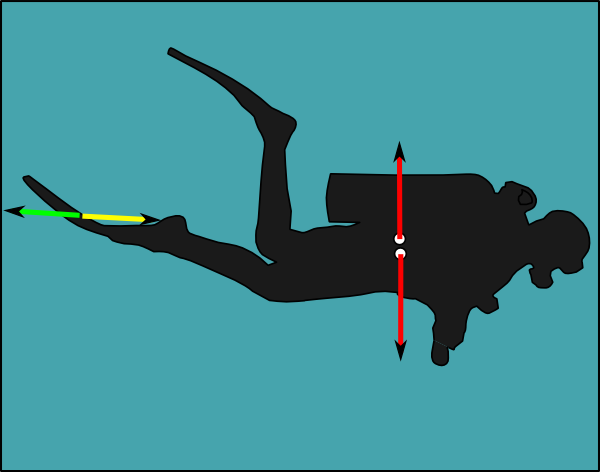
Diver trim level
We have talked about the importance of using the right amount of lead weights while you
dive, and how too much weight can actually make it very difficult to control your
buoyancy. Now we are going to expand on the subject of weights, and discuss how to distribute weights properly to achieve a good trim during our
dive.
What is 'trim'? What does it have to do with perfecting your buoyancy while scuba diving?
The
definition of trim is '
the diver's attitude in the water column, in terms of balance and alignment with the direction of motion'. Erm... guess that is not so clear! So let's forget the jargon.
Simply put, trim is your body position; whether you are horizontal or vertical, and whether you are balanced left to right or sort of lopsided.
A balanced, stable, horizontal body position is considered 'good trim'.
Conversely, bad trim is a head-up-feet-down position (aka seahorse-style diving). Or when your weights are all on one side and you are swimming around like a very confused flounder. Get the idea, right?
If you have read the previous sections of this
Buoyancy Basics blog series, you already know why it's best to keep a horizontal body position, with your legs at the same height as your torso. First, it will make it much easier to control your
buoyancy because as you kick with your fins you will move forward, not upwards. Second, it will reduce the effort required to move forward, because it minimizes your profile, which in turn makes it easier to overcome the resistance of the water.
Part 1: Why is buoyancy important?
Part 2: Neutral Buoyancy defined - Positive or Negative?
Part 3: How do I correct my buoyancy while scuba diving?
Part 4: Scuba diving and correct weight
Your next question might be: "How do I know what
trim I have?"
Good question! You see, trim is the posture your body adopts naturally, without you forcing it. So the best way to test your trim is to use the same trick we used for testing your buoyancy.
Remember? Stop moving, breathe normally, and see what happens.
You will know that you have great
trim if you naturally stay in your horizontal starting position.
If you don't have great trim, several things might happen: you might feel that your feet drop and you almost immediately find yourself in a more vertical position. Or that you roll around and find yourself staring at the surface like an upside-down turtle. Or any number of other things. The point is - if your natural posture, or
trim, is not a stable horizontal position, you will spend a lot of energy and make a lot of unnecessary movements just to get into it. And that means a less relaxed and shorter (because of the higher air consumption) dive.
And here is where the weight distribution comes into play... Your
trim is determined by many factors, and one of the most influential ones is how and where you distribute your
weights.
Having all of your
weights on a weight belt around your waist might not be the best option, because the weights will pull the lower part of your body down, while the air in you BCD will pull your torso up. Using more weights than the minimum necessary will just exacerbate the problem, so make sure you are properly weighted to begin with! BCDs with integrated weight systems usually position the weights a little bit higher up, so that might help. Also, many BCDs have small weight pockets higher up on the back, next to the tank. If that still doesn’t get you in the right trim, try putting a weight on a tank-strap and strap it on the tank, close to the valve. All these things might help to tilt your body a bit more forward.
Other times the problem might not even be the weights so much as the fins. Some fins are very negatively buoyant, and will drag your feet down no matter what you do with your weights. In that case you could try using lighter fins. When it comes to trim there is no one-size-fits-all solution, because every equipment configuration and every person is different. Experiment and see what works for you.
But watch out! One word of caution... while it is ok and even fun to play around with the distribution of weights to see how it affects your
trim, remember that you should always be able to ditch enough
weights in an emergency to make you positively buoyant, even if you can't inflate your BCD. So never put most of your weights in places where you can't quickly and easily ditch them. When you've found a weight configuration that seems to work, test to see if you can maintain a positive buoyancy at the surface with an empty BCD when you ditch your weight belt or your quick-release weight pockets.
Something else you can try to find a
good trim underwater; modify the position of your arms and legs.
Now, we're not asking you to adopt some bizarre yoga position! It's just a matter of bending the legs and extending the arms. If you find that your fins keep dragging your feet down, try keeping your thighs in line with your torso, but bend your legs upwards at the knees. This will bring the weight of your fins closer to your center of gravity, and might stop them from dragging your feet down. As for your arms, try extending them in front of you. The weight of your arms will also act as a lever, tilting you slightly forward. Doing just these two things –bending the legs upwards and extending the arms in front- is sometimes enough to correct your trim! And it has one added benefit: you will look like a total
pro diver.
To finish, here's a small disclaimer!
Although a stable, horizontal position is generally considered the
best trim, sometimes you actually might want a different body position because it might better suit you for a specific
dive. For example, if you are drifting along a near-vertical drop-off, you might want a more vertical body position. Or if you are muck diving, looking for tiny nudibranches in the sand, you might even want a slightly head-down position.
The bottom line is that a good trim will be any one that minimizes the effort for the
diver, but it has to be conscious and stable, easy to maintain. For most of the beautiful coral reefs you can visit at
SUB AQUA DiveCenters in Thailand and Maldives, that position is, in effect, a horizontal one, where you minimize drag and make buoyancy control a breeze.
Don't you feel like jumping in the water right now to try out all these tips and tricks, and see how fast you improve your buoyancy and air consumption? Book your holidays in any of our dream destinations with a
SUB AQUA DiveCenter!
Image credit: All images used within this article were produced by
Peter Southwood.
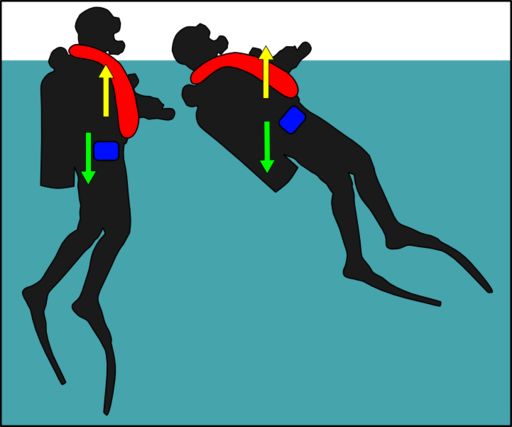
Diver with center of buoyancy at front rotates backwards
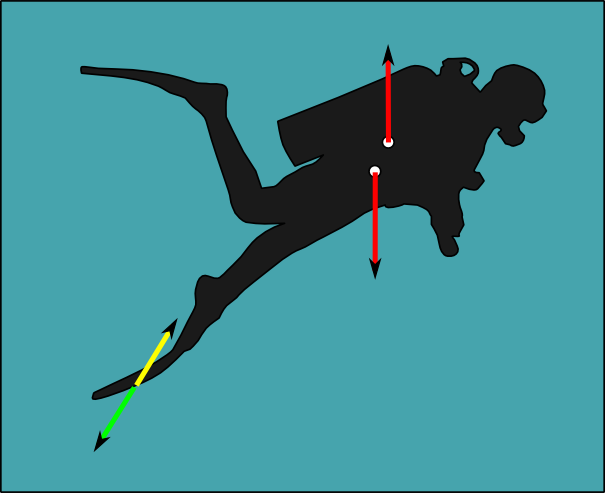
Are your fins weighing you down?
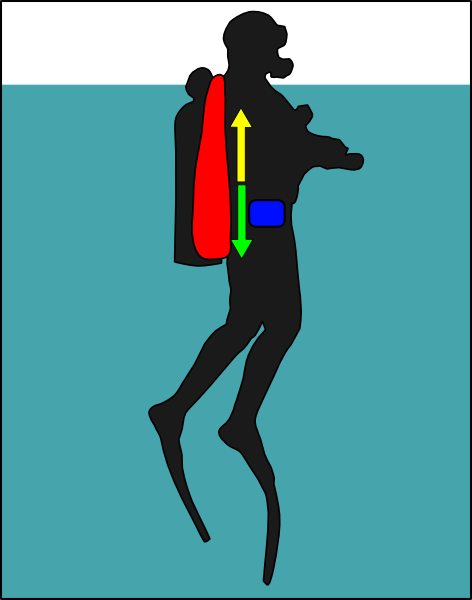
Good position for drifting wall dives